Perfectly Broken: Why the Most Honest Moments in Music Are Winning Right Now
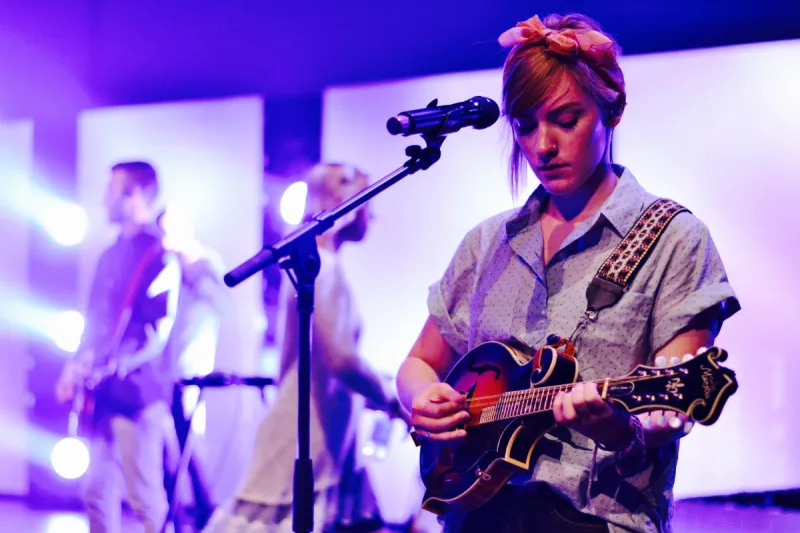
Photo: musician recording emotional performance bedroom studio lo-fi, via c.pxhere.com
There's a specific kind of moment happening a lot lately. An artist posts a voice memo — no mixing, no mastering, maybe recorded on an iPhone in a bathroom at 2 a.m. — and it racks up millions of plays before the weekend is over. The comments flood in: I felt this in my chest. Why am I crying in the Dunkin' parking lot. This is the most real thing I've heard all year.
Meanwhile, some immaculately produced major-label release with a six-figure video drops the same week and disappears into the algorithmic void like it never existed.
Something is shifting. And it's not subtle anymore.
The Exhaustion Is Real
We've been marinating in over-produced culture for a long time. Streaming rewards consistency and polish. Social media rewards aesthetics. The result? Years of content so buffed and airbrushed that it stopped feeling like anything at all.
People are tired. Not just tired of bad music — tired of perfect music that somehow leaves them cold. There's a collective sensory fatigue that's set in, and audiences are responding by gravitating hard toward whatever feels like it came from an actual human being who was actually feeling something when they made it.
Producer and multi-instrumentalist Maya Solís, who works primarily out of her home studio in Austin, describes it plainly: "People can hear when you're performing emotion versus when you're living it. And right now, they're not interested in the performance."
Maya's recent project — recorded mostly live with minimal overdubs — found an audience she hadn't expected. "I thought it was going to be a small thing, something just for me. But the response was bigger than anything I'd done before. I think because I wasn't trying to impress anyone."
Imperfection as Signal
Here's the counterintuitive truth: in a landscape saturated with technical precision, a crack in the voice or a slightly off-tempo moment actually stands out. It reads as a signal. It says: this person wasn't optimizing. They were just being.
New York-based singer-songwriter Darius Okafor has built a following almost entirely on stripped-down recordings where you can hear the room, hear him breathing, sometimes hear him stop and restart a line. "I used to be embarrassed by all that stuff. I'd spend hours trying to clean it up. Then I put out something I almost didn't release because it felt too raw, and that was the one that connected."
Darius isn't alone in this discovery. Across genres — indie folk, R&B, hyperpop, country, underground rap — the moments that are landing hardest tend to share a quality that's easier to feel than define. There's a word people keep reaching for: real.
But what does real actually mean when everything is content?
The Authenticity Paradox
Here's where it gets complicated. Authenticity, the moment it becomes a strategy, stops being authentic. And plenty of artists and brands have figured out that performing rawness is its own kind of polish.
Content creator and music blogger Jade Whitmore, who runs a popular account dedicated to surfacing under-the-radar artists, sees this constantly. "There's definitely a version of 'lo-fi aesthetic' that's just a filter someone slapped on something. Audiences are getting better at sniffing that out. The real thing has a different texture — you can feel the difference even if you can't explain it."
Jade describes it as the difference between vulnerability and vulnerability-as-branding. "One of them makes you feel less alone. The other one makes you feel like you're being sold something."
The artists who are genuinely cutting through right now tend to share a quality beyond just sonic rawness: they're emotionally consistent across everything they put out. Their imperfections aren't strategic — they're just present in the work because the person is present in the work.
What This Says About Us
It's worth pausing on what this collective appetite for emotional honesty actually reflects about where we are culturally.
The past few years have been a lot. Pandemic isolation, political noise that never really quieted down, economic anxiety that's become a permanent background hum for most people under 40. A lot of the culture that emerged from that period tried to be escapist — maximalist, shiny, relentlessly upbeat. And some of it worked. But a lot of it felt like being handed a balloon at a funeral.
What people seem to want now is company in the hard stuff. Not solutions, not distractions — just the sense that someone else is also standing in the middle of the mess and deciding to make something anyway.
Solís puts it this way: "I think people are craving proof that other people feel things. Like, real confirmation. Not a performance of feeling. Actual feeling."
The New Standard
None of this means technical skill is dead or that well-produced music can't move people. It means the bar has shifted. The question audiences are asking isn't how did they make this? It's did they mean it?
That's a harder question to fake. And it's a harder standard to meet — not because it requires expensive equipment or industry connections, but because it requires a willingness to be actually seen. To put something out that isn't protected by layers of production sheen, and trust that the thing underneath is enough.
For a lot of artists, that's scarier than learning a new DAW or booking a better studio. Vulnerability is a technical skill of its own, and it's one that can't be outsourced.
Okafor, who's currently working on his first full-length project, says he's trying to carry that lesson forward even as his resources grow. "I have access to better stuff now. Better mics, better rooms. But I'm trying not to let that become a reason to hide. The goal is still the same: make something that feels like it came from a person."
The Vibe Doesn't Lie
There's something almost old-fashioned about where this is all landing. Strip away the algorithms and the content strategies and the discourse about authenticity, and what you're left with is pretty simple: people want to feel something, and they want to feel like the person who made the thing felt something too.
That was always the deal with music. The technology changes, the platforms change, the aesthetics cycle through. But the fundamental transaction — here is something true, I hope it reaches you — that hasn't moved.
In 2024, the most resonant artists aren't the ones with the cleanest sound. They're the ones willing to let you hear them think, breathe, and occasionally fall apart. That's the vibe that's going viral. And honestly? It makes sense.
We've had enough of perfect. Give us real.